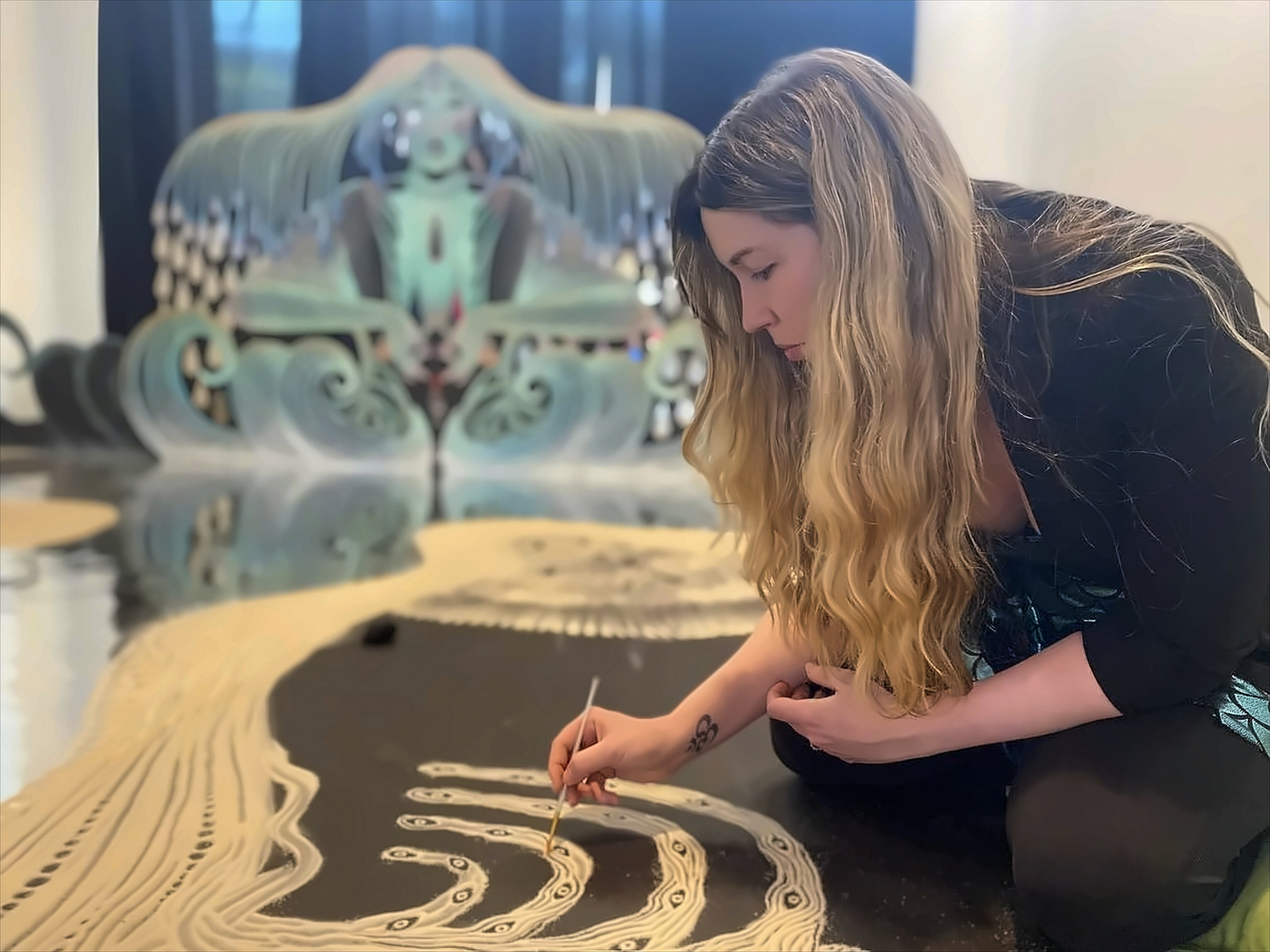
Photo Credit: The News Tribune
English:
For River Reishi, dreaming is a practice that taps into a shared language between nature and spirit. Her work gives visual form to this language, weaving together stories, mythologies, symbols, and landscapes to explore the ways humans make meaning through the natural world.
River draws inspiration from the syncretism between Indigenous traditions and religions such as Buddhism and Christianity, understanding syncretism as a means of cultural survival and art as a conduit through which stories and ways of knowing can return to collective consciousness.
Working across sculpture, installation, digital painting, illustration, and participatory art, River uses art not only as a form of expression, but as a practice of transformation. Art has long been her primary way of navigating the strain of being neurodivergent in neurotypical contexts and a means of transmuting sadness and trauma into hope. Throughout her work, she imagines ancient and alternative worlds that recognize the sacredness of queer and sapphic connection and the power of femme identities beyond fertility. From these imagined worlds, she creates new myths, symbols, figures, and artifacts.
Just as rivers both shape and are shaped by the landscapes through which they move, River grounds these explorations in traditions and ancestral geographies that follow the shores of the Baltic, North, and Mediterranean Seas. Water, shorelines, folklore, and the movement of materials between land and sea recur throughout her practice.
Central to this work is an ongoing series of ephemeral shoreline installations created with locally gathered sand and natural materials. River has created these site-responsive works along the Pacific Northwest coast of the United States, including installations at the Coos Art Museum and Foss Waterway Seaport Maritime Museum, as well as in Iceland. Her broader work has been exhibited internationally across Europe and North America, including in Iceland, Sweden, Denmark, Spain, and Mexico. Emerging directly from the landscapes in which they are made, the shoreline installations bring the spirit and stories of a place into temporary form before their materials are ultimately returned to the landscape from which they came.
This practice grows from River’s study of sand art and its expressions across cultures, including the Slavic tradition of sypanie piaskiem and related traditions of ephemeral art such as Buddhist sand mandalas and Mexican tapetes. Though these traditions have distinct histories and meanings, River is drawn to the ways each uses temporary materials to create symbols, tell stories, mark sacred or communal space, and embrace the act of creation and return. Through her own sand installations, impermanence becomes part of the work itself: an invitation to encounter landscape not simply as a setting for human stories, but as a participant in them.
Español:
Para River Reishi, soñar es una práctica que permite acceder a un lenguaje compartido entre la naturaleza y el espíritu. Su obra da forma visual a este lenguaje, entrelazando historias, mitologías, símbolos y paisajes para explorar las maneras en que los seres humanos construimos significado a través del mundo natural.
River se inspira en el sincretismo entre las tradiciones indígenas y religiones como el budismo y el cristianismo, entendiendo el sincretismo como una forma de supervivencia cultural y el arte como un conducto a través del cual historias y formas de conocimiento pueden regresar a la conciencia colectiva.
A través de la escultura, la instalación, la pintura digital, la ilustración y el arte participativo, River utiliza el arte no solo como forma de expresión, sino también como una práctica de transformación. Desde hace mucho tiempo, el arte ha sido su principal manera de navegar las tensiones de ser neurodivergente en contextos neurotípicos, así como un medio para transmutar la tristeza y el trauma en esperanza. A lo largo de su obra, imagina mundos antiguos y alternativos que reconocen el carácter sagrado de las conexiones queer y sáficas, así como el poder de las identidades femeninas más allá de la fertilidad. A partir de estos mundos imaginados, crea nuevos mitos, símbolos, figuras y artefactos.
Así como los ríos moldean los paisajes que atraviesan y, a su vez, son moldeados por ellos, River arraiga estas exploraciones en tradiciones y geografías ancestrales que recorren las costas de los mares Báltico, del Norte y Mediterráneo. El agua, las costas, el folclore y el movimiento de materiales entre la tierra y el mar aparecen de manera recurrente en su práctica.
Un elemento central de su obra es una serie continua de instalaciones efímeras en la costa, creadas con arena recolectada localmente y materiales naturales. River ha realizado estas obras en diálogo con el lugar a lo largo de la costa del noroeste del Pacífico de Estados Unidos, incluyendo instalaciones en el Coos Art Museum y el Foss Waterway Seaport Maritime Museum, así como en Islandia. Su obra también se ha exhibido internacionalmente en Europa y Norteamérica, incluyendo Islandia, Suecia, Dinamarca, España y México. Surgidas directamente de los paisajes donde son creadas, las instalaciones costeras dan forma temporal al espíritu y las historias de un lugar antes de que sus materiales sean finalmente devueltos al paisaje del que provienen.
Esta práctica nace del estudio de River sobre el arte con arena y sus expresiones en distintas culturas, entre ellas la tradición eslava de sypanie piaskiem y otras tradiciones relacionadas de arte efímero, como los mandalas de arena budistas y los tapetes mexicanos. Aunque cada una de estas tradiciones posee su propia historia y significado, a River le interesa la manera en que utilizan materiales temporales para crear símbolos, contar historias, marcar espacios sagrados o comunitarios y abrazar el acto de crear y devolver. En sus propias instalaciones de arena, la impermanencia se convierte en parte de la obra misma: una invitación a encontrarnos con el paisaje no simplemente como escenario de las historias humanas, sino como participante en ellas.
Íslenska:
Fyrir River Reishi er draumurinn leið til að tengjast sameiginlegu tungumáli náttúru og anda. Verk hennar gefa þessu tungumáli sjónrænt form og flétta saman sögur, goðsagnir, tákn og landslag til að kanna hvernig við sköpum merkingu í gegnum tengsl okkar við náttúruna.
River sækir innblástur til samruna frumbyggjahefða og trúarbragða á borð við búddisma og kristni. Hún lítur á slíkan samruna sem leið til að varðveita menningu og á listina sem farveg þar sem sögur og þekking geta öðlast nýtt líf í sameiginlegri vitund okkar.
River vinnur með höggmyndir, innsetningar, stafrænt málverk, myndskreytingar og þátttökulist og nálgast listina ekki aðeins sem tjáningarform heldur einnig sem leið til umbreytingar. Listin hefur lengi verið hennar helsta leið til að takast á við álagið sem fylgir því að vera taugafjölbreytt í umhverfi sem miðast við taugadæmigerð viðmið, og jafnframt leið til að umbreyta sorg og áföllum í von. Í verkum sínum ímyndar hún sér forna og aðra mögulega heima þar sem heilagleiki hinsegin og safískra tengsla er viðurkenndur og kvenleiki býr yfir krafti óháð frjósemi. Úr þessum ímynduðu heimum skapar hún nýjar goðsagnir, tákn, verur og gripi.
Rétt eins og ár móta landslagið sem þær renna um og mótast jafnframt af því, grundvallar River þessar rannsóknir í hefðum og arfleifð sem rekja má meðfram ströndum Eystrasalts, Norðursjávar og Miðjarðarhafs. Vatn, strandir, þjóðtrú og ferðalag efna milli lands og sjávar eru endurtekin stef í listsköpun hennar.
Mikilvægur hluti af verkum River er viðvarandi röð hverfulla strandinnsetninga sem unnar eru úr staðbundnum sandi og náttúrulegum efnum. Hún hefur skapað þessi staðbundnu verk meðfram Kyrrahafsströnd norðvesturhluta Bandaríkjanna, meðal annars við Coos Art Museum og Foss Waterway Seaport Maritime Museum, auk þess að vinna slík verk á Íslandi. Verk hennar hafa einnig verið sýnd víða á alþjóðlegum vettvangi í Evrópu og Norður-Ameríku, meðal annars á Íslandi, í Svíþjóð, Danmörku, Spáni og Mexíkó. Strandinnsetningarnar spretta beint úr landslaginu þar sem þær verða til og færa anda og sögur staðarins í tímabundið form áður en efnunum er að lokum skilað aftur til þess landslags sem þau komu úr.
Þessi listsköpun byggir á rannsóknum River á sandlist og birtingarmyndum hennar í ólíkum menningarheimum, þar á meðal slavnesku hefðinni sypanie piaskiem og skyldum hefðum hverfullar listar á borð við sandmandölur búddisma og mexíkósk tapetes. Þótt hver þessara hefða eigi sér sérstaka sögu og merkingu heillast River af því hvernig þær nýta hverful efni til að skapa tákn, segja sögur, marka heilög eða sameiginleg rými og leggja merkingu í sjálft ferli sköpunar og endurkomu. Í sandinnsetningum hennar verður hverfulleikinn hluti af verkinu sjálfu: boð um að upplifa landslagið ekki aðeins sem vettvang mannlegra sagna, heldur sem virkan þátttakanda í þeim.